Day 0
Date of death
The death occurs. Nothing in any commercial dataset has changed yet, and the identity remains fully valid to every automated check.
A deceased person's identity is the perfect fraud instrument. It has a real Social Security number, a clean credit history and, critically, no living owner to notice, report or dispute anything. This is what fraudsters do with it, and why the control that stops them is speed rather than sophistication.
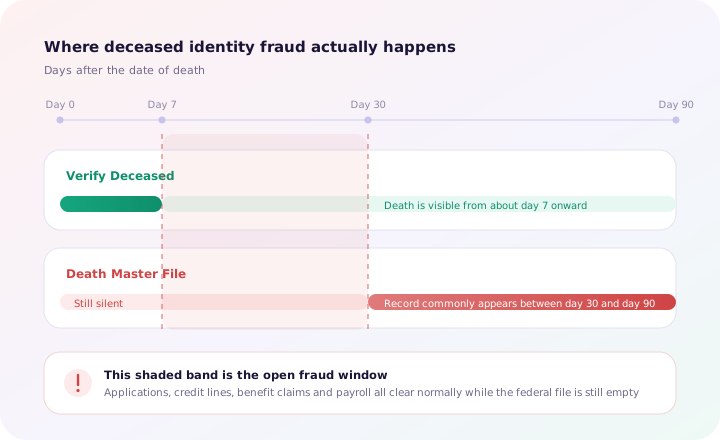
Deceased identity fraud is not opportunistic. It is scheduled around a data lag that fraudsters understand better than most institutions do.
The death occurs. Nothing in any commercial dataset has changed yet, and the identity remains fully valid to every automated check.
Obituaries and public notices make the death discoverable to fraudsters long before it reaches screening data. Applications begin.
New credit lines behave normally to avoid early detection, then are drawn down in full. Benefit and payroll payments continue uninterrupted.
The Death Master File reflects the death. By this point the loss is already booked and recovery odds have collapsed.
Every control in this sequence fires too late except one: screening the identity against a deceased index that is measured in days rather than months.
Cards and personal loans opened weeks after death, before any national file reflects the event. The account performs briefly, then busts out.
A deceased person's SSN is used to pass onboarding and payroll checks, exposing the employer to penalties and remediation costs.
Retirement, annuity and public benefit payments keep flowing to an account controlled by someone else, creating a growing clawback liability.
Claims and refunds filed against a decedent's identity, often detected only after the payout has already cleared.
A real deceased SSN is blended with a fabricated name and date of birth to build a synthetic profile that looks clean to legacy checks.
In the weeks between death and probate, dormant accounts are drained while no one is actively monitoring the relationship.
Screening against a file that lags by one to three months tells you a loss already happened. Screening against a file refreshed daily tells you not to take the risk in the first place. The mechanism is identical; only the timing differs, and timing is the entire control.
The loss is booked. You are now running a recovery process with poor odds.
The application is declined and the payment is held. There is nothing to recover.
Deceased identity fraud, often called ghosting, is the use of a dead person's identity to obtain credit, employment, benefits, insurance payouts or medical services. It is attractive to fraudsters because the victim cannot detect it, cannot report it and cannot dispute it, so the fraud frequently runs unchallenged until an institution absorbs the loss.
Because the identity still appears completely valid. Credit files remain active, the Social Security number is not yet flagged in most commercial datasets, and the family is focused on grieving rather than monitoring accounts. Federal death files typically take one to three months to publish the death, so every automated check an institution runs during that window returns a clean result.
They overlap heavily. Synthetic identities are frequently constructed around a real Social Security number belonging to a deceased person, combined with a fabricated name and date of birth. Because the SSN is genuine, the profile survives basic validation. Checking the SSN against a current deceased index exposes the contradiction that conventional identity verification misses.
Common patterns include a credit application from an identity with a long, clean history but no recent activity; a sudden change of address or contact details shortly before an application; new accounts opened in quick succession across institutions; and applications where the SSN issue date is inconsistent with the stated date of birth. Any of these paired with a deceased-index match is a strong signal.
Prevention requires deceased data that is current enough to matter. Screening against a file that lags by one to three months is detection after the fact, not prevention. Screening at the point of decision against an index refreshed daily, and re-screening existing portfolios on a schedule, moves the control from recovery to prevention.
Credit issuers and lenders see the highest volume because credit is the fastest way to convert a stolen identity into cash. Government benefit programmes, pension and retirement plans, insurance carriers and healthcare payers all carry substantial exposure, and employers are increasingly targeted because a deceased SSN can pass standard onboarding checks.
Looking for something else? See all frequently asked questions
See how a seven-day deceased index changes your fraud numbers. Sandbox credentials are issued before any commercial commitment.