Verify Deceased by LeadCruncher

Death verification with records in 7 days, not 3 months

Deceased-identity fraud lives in the gap between the date of death and the date the data catches up. We collect decedent records directly from source jurisdictions in all 50 states and publish daily, so you can decline the application, freeze the account or hold the payment while it still matters.

  • Records within days of death, not the 30 to 90 day lag of federal files
  • Real-time REST API plus bulk batch screening
  • Built for banks, lenders, insurers, pensions and government agencies

Contracted access for institutions with a documented permissible business purpose.

POST /v1/verify
Robert Hensley · DOB 03/11/1948
DECEASEDDate of death · June 19, 2026
0.98
Record age6 days
SourceState vital record
Latency241 ms
lastNamedateOfBirthssnstate
Weekly refreshNew records every week
All 50 statesSource-level collection
7 DaysAverage time to recordDeceased records surface in our index within a week of the date of death.
50 StatesNationwide coverageSourced continuously from every US state and thousands of local jurisdictions.
WeeklyIndex refreshNew decedent records are ingested, matched and published every Week.
<300msMedian API responseReal-time verification fast enough to sit inline in your onboarding flow.
The blind spot

Every institution is screening against data that is already months old

The federal Death Master File sits at the end of a long reporting chain. A death is registered locally, moves through state processing, is reported to the Social Security Administration, then processed and distributed. By the time it reaches your screening vendor, the identity has usually been exploitable for weeks.

  • Credit is opened in the decedent's name and busts out before anyone notices
  • Benefit, pension and annuity payments keep disbursing into a controlled account
  • A genuine SSN seeds a synthetic profile that passes conventional identity checks
How deceased identity fraud works

Time from date of death to availability

Verify Deceased~7 days
Death Master File30 to 90 days
Exposure window closedUp to 83 days

Illustrative comparison based on typical publication lag. Actual timing varies by jurisdiction.

Capabilities

Built for institutions that carry the loss

Speed is the product. Everything else exists to make that speed usable inside a regulated decision process.

The fastest deceased index in the US

We ingest decedent records directly at the source, which means a death typically appears in our index within a week. Most national files take one to three months to reflect the same event, and that gap is exactly where fraud happens.

Stop ghosting and synthetic identity fraud

Fraud rings harvest the identities of recently deceased Americans to open credit cards, claim benefits, secure employment and drain accounts. Screening against a current deceased index closes that window before a loss is booked.

Drop-in REST API

A single authenticated POST returns a deterministic match verdict, confidence score and date of death. JSON in, JSON out. Most teams are live in a day, with sandbox keys available immediately.

Bulk portfolio screening

Upload an entire customer, member or policyholder file and get a scored deceased-match report back. Ideal for quarterly portfolio hygiene, escheatment reviews and pre-audit clean-up.

Deterministic matching, not guesswork

Matching runs on name, date of birth, SSN and last known address with a transparent confidence score on every hit, so your analysts know exactly why a record matched before they action it.

Audit-ready evidence trail

Every verification is logged with a timestamp, the matching criteria used and the source classification, giving you the documentation your compliance, audit and regulatory reviewers ask for.

How it works

From identity to decision in four steps

STEP 01

Send the identity

Post the name, date of birth and any combination of SSN or last known address to our verification endpoint, or upload a batch file through the dashboard.

STEP 02

We match against the live index

The identity is scored against our continuously refreshed nationwide deceased index, built from source records rather than downstream aggregators.

STEP 03

Get a decision-ready verdict

You receive a clear deceased / not-found verdict, a confidence score, the date of death where available and a reference ID you can store for audit.

STEP 04

Act before the loss

Block the application, freeze the account, pause the benefit payment or route to manual review, all before funds move and while recovery is still possible.

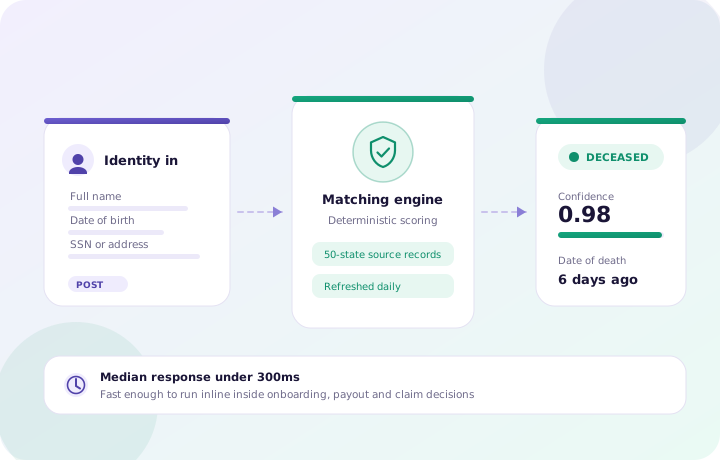
Death verification request flow: an identity record is posted, matched against daily 50-state decedent records, and returned as a deceased verdict with a confidence score and date of death
A single authenticated request returns a scored verdict, the date of death and an audit reference in under a third of a second.
Developer experience

One endpoint. One decision. Live in a day.

No ingestion pipeline, no matching engine, no flat-file processing to maintain. Post an identity, get a scored verdict back in under a third of a second.

  • Median response under 300ms, so it runs inline in onboarding
  • Batch up to 10,000 identities per request
  • Idempotency keys make every retry safe
  • Sandbox credentials before you contract
Read the API overview
200 OK · application/json
{
  "referenceId": "vd_9f31c0a7be2d",
  "status": "deceased",
  "confidence": 0.98,
  "dateOfDeath": "2026-06-19",
  "matchedFields": ["lastName", "dateOfBirth", "ssn", "state"],
  "recordAgeInDays": 6,
  "source": "state_vital_record",
  "verifiedAt": "2026-06-25T14:22:08Z"
}
Comparison

Verify Deceased vs the Death Master File

If your current deceased screening is built on the DMF, this is what you are trading away.

CriteriaVerify DeceasedSSA Death Master File
Time from death to availabilityTypically within 7 days Commonly 30 to 90 days, sometimes longer
Update frequencyDaily ingestion and publication Weekly or monthly file drops
State-reported deathsCaptured directly from source jurisdictions Public DMF excludes state-protected records
Access modelReal-time REST API, batch upload and dashboard Flat-file subscription requiring in-house processing
Security & governance

Handled the way your risk team expects

Encrypted end to end

TLS 1.2+ in transit and encryption at rest. We never resell the identities you submit.

Permissible-use governed

Access is contracted to vetted institutions with a documented permissible business purpose.

Retention you control

Configurable submission retention windows so the product fits your data-governance policy.

Named integration support

Enterprise accounts get a named engineer through sandbox, certification and go-live.

FAQ

Death verification questions, answered

Frequently asked questions

What is death verification and why does timing matter so much?

Death verification is the process of confirming whether a given identity belongs to someone who has died. Timing is the entire problem. Fraud committed with a deceased person's identity is concentrated in the first weeks after death, because that is when the identity still looks completely legitimate to every automated check. Our index typically reflects a death within about seven days, while the federal files most organizations rely on commonly take one to three months. That gap is where the losses occur.

How is Verify Deceased faster than the Social Security Death Master File?

The Death Master File is a downstream product. A death must be registered, processed and then propagated into the file before subscribers see it, and the public version also excludes records that states protect. We collect decedent records directly from source jurisdictions across all fifty states and publish daily, which removes several links from that chain and typically compresses availability from months to about a week.

Who is this product built for?

Institutions that carry real financial or compliance exposure when a deceased identity goes undetected: banks and credit unions, lenders and card issuers, insurance carriers, pension and retirement plans, government benefit agencies, healthcare payers and providers, employers and background screening firms, and debt collection agencies. Access is contracted to organizations with a documented permissible business purpose.

How do we access the data: API, batch, or both?

Both, and most customers use both. A real-time REST endpoint handles inline checks during onboarding, underwriting or claim intake with a median response under 300 milliseconds. Batch verification accepts up to 10,000 identities per request for portfolio sweeps. There is also a dashboard for manual lookups and file uploads, plus webhook-based continuous monitoring for enrolled portfolios.

What information do we need to submit for an accurate match?

Name and date of birth are the minimum. Adding a Social Security number raises confidence substantially, and a last known address helps disambiguate common names. Every response returns a confidence score plus the specific fields that matched, so you can set different action thresholds for different risk levels rather than treating all matches identically.

How accurate is the matching and how do we handle false positives?

Matching is deterministic and every result carries a transparent confidence score with a matched-field breakdown. The recommended pattern is to auto-action only high-confidence matches and route everything below your threshold to human review. For irreversible actions such as terminating a benefit, we recommend holding rather than terminating on first match and confirming before the change is made permanent.

How long does integration take?

Most engineering teams complete the integration in about a day. It is a single authenticated POST with a JSON body and a JSON response. We issue sandbox credentials with deterministic test identities up front, so your team can build and certify the full flow, including deceased, not-found and low-confidence paths, before contracting is finalized.

How is the data we submit protected?

Submissions are encrypted in transit using TLS 1.2 or higher and encrypted at rest. We do not resell the identities you submit to us. Retention windows for submitted data are configurable so the integration can be aligned with your own data-governance policy, and specifics are agreed during contracting.

What does it cost?

Pricing is volume-based and structured around your expected verification throughput, with separate tiers for real-time API calls, batch screening and continuous monitoring. Enterprise agreements include named integration support. Contact our team with your use case and expected volume for a quote.

What is the relationship between Verify Deceased and LeadCruncher?

Verify Deceased is a LeadCruncher product. LeadCruncher operates nationwide data infrastructure covering more than 160 million US properties with daily updates, and Verify Deceased applies that same source-level collection and daily-refresh discipline to decedent records for identity verification.

Close the gap before the next application lands

Tell us your use case and expected volume. We will issue sandbox credentials so your team can build and certify the integration before any commercial terms are agreed.