Verify Deceased vs the SSA Death Master File
The Death Master File has been the default deceased data source for decades, largely because nothing faster existed. Here is an honest, criterion-by-criterion comparison of what changes when you screen against a source-level index instead of a downstream federal extract.
Seven criteria that decide the outcome
Why the Death Master File lags
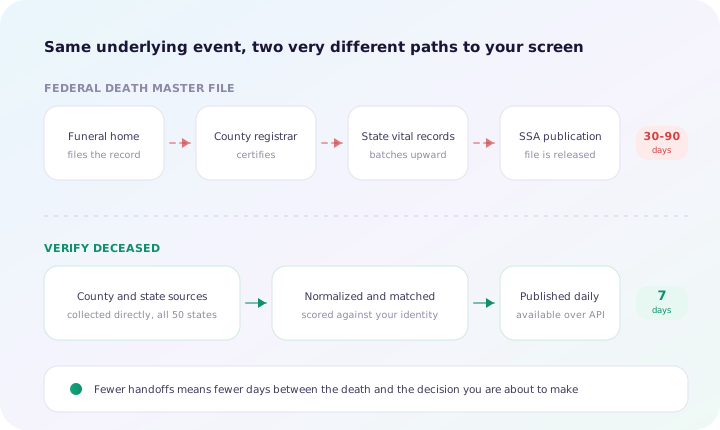
The DMF is not inaccurate. It is simply positioned at the end of a long reporting chain. Each handoff in that chain adds delay, and the cumulative effect is the exposure window fraudsters plan around.
- 1Local registration
The death is registered with a local or county authority.
- 2State processing
The record moves through state vital-records processing.
- 3Federal reporting
The state reports the death to the Social Security Administration.
- 4File compilation
The record is processed into the Death Master File.
- 5Subscriber distribution
Your vendor receives the file and republishes it downstream.
We collect at step one and two, which removes three links from the chain. The public DMF additionally excludes records that individual states protect, so coverage differs as well as timing.
Which should you use?
- Your obligation is to prevent fraud, not to consume a specific named file
- You need a decision inside an onboarding or underwriting flow
- You do not want to build and operate matching infrastructure
- Recent deaths are the population that actually hurts you
- A regulation or contract names the DMF specifically
- You already operate a certified pipeline you must retain
- You need the historical archive for retrospective analysis
Most customers run us as the primary real-time control and retain the DMF only where it is contractually required.
Moving off a flat-file pipeline
You are replacing an ingestion pipeline, a storage layer and a matching engine with a single authenticated endpoint. Most teams complete the transition in days.
Request sandbox access
Tell us your use case and volume. We issue sandbox credentials and the full API reference.
Build against fixtures
Deterministic test identities cover deceased, not-found and low-confidence paths end to end.
Certify and contract
We review your permissible use, agree throughput tiers and countersign the data agreement.
Go live with support
Production keys are issued and a named engineer monitors your first weeks of live traffic.
Death Master File questions, answered
Frequently asked questions
The Death Master File, or DMF, is a file maintained by the Social Security Administration containing records of reported deaths. A limited-access version is available to certified subscribers with a legitimate fraud-prevention purpose, while a public version excludes records that individual states protect. It has been the default deceased data source for decades, largely because there was no faster alternative.
Because it sits at the end of a reporting chain. A death is registered locally, passed through state processing, reported to the Social Security Administration, then processed into the file and distributed to subscribers. Each hop adds delay, and the cumulative effect commonly puts availability one to three months after the death itself.
Most customers treat it as the primary real-time control and retain the DMF where a specific regulation or contract names it. The practical value is coverage of the recent window the DMF cannot reach. If your obligation is to prevent fraud rather than to consume a specific named file, a faster source is a direct upgrade.
Not for our service. Using Verify Deceased involves a standard commercial data agreement and an onboarding review confirming your permissible business purpose. It does not require you to hold or maintain Limited Access DMF certification, which removes the associated attestation and periodic audit overhead for organizations that only held it for fraud screening.
The DMF is delivered as flat files, so you build and maintain the ingestion pipeline, storage, deduplication and matching logic yourself, and you own the accuracy of that matching. We deliver a single REST endpoint that returns a scored verdict directly, so most teams integrate in about a day and never operate matching infrastructure.
We collect from source jurisdictions across all fifty states rather than consuming a downstream federal extract, so our coverage is not shaped by the exclusions applied to the public DMF. Coverage specifics for your particular use case are confirmed during onboarding.
Looking for something else? See all frequently asked questions
Run both and compare the match rate
The fastest way to size the difference is to screen the same file against both sources. We will issue sandbox credentials so you can do exactly that.