POST
/v1/verifySingle identity verification
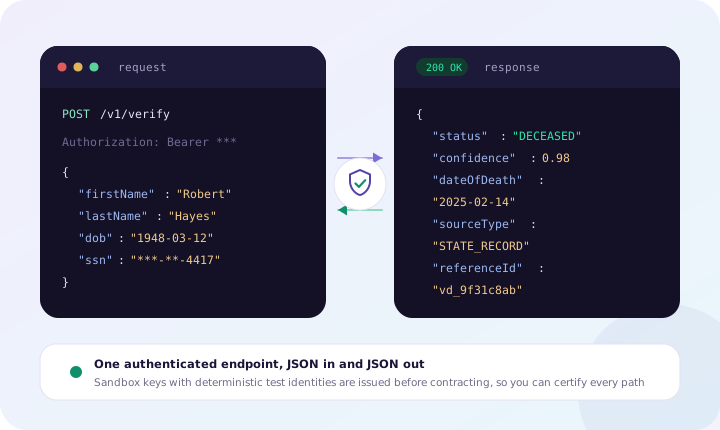
Real-time deceased check for one identity. Returns a verdict, confidence score and date of death.
One authenticated POST returns a deterministic deceased verdict, a confidence score and the date of death. No ingestion pipeline to build, no matching engine to maintain, no flat files to reconcile.
curl -X POST https://api.verifydeceased.com/v1/verify \
  -H "Authorization: Bearer $VD_API_KEY" \
  -H "Content-Type: application/json" \
  -d '{
    "firstName": "Robert",
    "lastName": "Hensley",
    "dateOfBirth": "1948-03-11",
    "ssn": "***-**-4417",
    "address": {
      "line1": "8023 Jennet Street",
      "city": "Alta Loma",
      "state": "CA",
      "postalCode": "91701"
    }
}'Real-time checks, portfolio batches, audit retrieval and continuous monitoring, all under one API key.
/v1/verifyReal-time deceased check for one identity. Returns a verdict, confidence score and date of death.
/v1/verify/batchSubmit up to 10,000 identities per request for asynchronous portfolio screening.
/v1/verify/{referenceId}Fetch a stored verification by reference ID for audit, dispute handling or reconciliation.
/v1/monitoring/subscribeRegister a portfolio for ongoing surveillance and receive a webhook the moment a match appears.
A median response under 300ms means the check runs inline without slowing your application flow.
Deterministic sandbox fixtures let your team build and test the full integration ahead of contracting.
Subscribe a portfolio once and get pushed a notification the moment any enrolled identity matches.
Every request accepts an idempotency key so network retries never double-bill or duplicate a record.
Track volume, match rate and latency by environment and API key from the dashboard.
Rate limits and throughput tiers sized for high-volume onboarding and nightly portfolio runs.
You build and certify the full integration before commercial terms are finalized, not after.
Tell us your use case and volume. We issue sandbox credentials and the full API reference.
Deterministic test identities cover deceased, not-found and low-confidence paths end to end.
We review your permissible use, agree throughput tiers and countersign the data agreement.
Production keys are issued and a named engineer monitors your first weeks of live traffic.
Every request carries a bearer token in the Authorization header. Keys are scoped per environment, so your sandbox key cannot reach production data and vice versa. Keys can be rotated from the dashboard at any time without downtime, and usage is tracked separately per key.
Median response time for a single verification is under 300 milliseconds, which is fast enough to run inline in an onboarding or underwriting decision. Rate limits and throughput tiers are sized to your expected volume and agreed during onboarding rather than fixed at a single ceiling.
Post up to 10,000 identities to the batch endpoint and receive a job reference immediately. The job is processed asynchronously and you can either poll for completion or register a webhook. Results come back with the same verdict, confidence score and matched-field structure as single verifications.
Yes. Every request accepts an idempotency key. If a network failure causes your client to retry, the original result is returned rather than a duplicate verification being created, so retries never double-bill or corrupt your audit trail.
With monitoring you enrol a portfolio of identities once. Whenever a newly published decedent record matches an enrolled identity, we push a webhook to your endpoint. This is the right pattern for existing customer books, annuitant files and active collection inventory, where the risk is a death occurring after your initial check.
Yes. We issue sandbox credentials with deterministic test identities covering every response path, including deceased, not-found and deliberately low-confidence matches, so you can build and certify the complete integration before commercial terms are finalised.
Looking for something else? See all frequently asked questions
Tell us your use case and expected volume and we will issue keys plus the full API reference so your team can start building immediately.